
The AI internal audit tool that finds the gaps in your ISO 17025 quality system
Point our AI internal audit tool at your quality system. It works through every clause, cites the document and page that supports compliance, and flags the requirements where your evidence does not exist yet. A qualified auditor reviews and approves before anything becomes final.
Built and running inside Precision ISO today. It supports ISO/IEC 17025:2017 and ISO 9001:2015, and it connects to Google Drive, SharePoint, or Microsoft 365.

Hundreds of questions, answered one clause at a time
Most accreditation bodies ask you to complete a preliminary checklist before the assessment. For every clause you name the applicable document, give a reference, and explain where the assessor will find the evidence. Labs do this by hand, and it costs days.
The checklist eats a week
You open the quality manual, then a procedure, then a form, and you repeat that loop for every requirement in the standard. Nothing about the work is difficult. All of it is slow.
You cannot see your own gaps
The people who wrote the documents are the least likely to notice what is missing from them. A fresh, systematic read across the whole repository catches what familiarity hides.
A procedure is not a record
An assessor rarely stops at what your procedure says should happen. They ask you to demonstrate that it happened. Missing records surface during the assessment, when fixing them costs the most.
Watch the AI internal audit tool find a missing record
One clause, start to finish. The system reads the laboratory's own documents, reaches a determination, cites the evidence by document and page, then explains what is missing.

Runs 1 min 30 seconds. Nothing loads from YouTube until you press play.
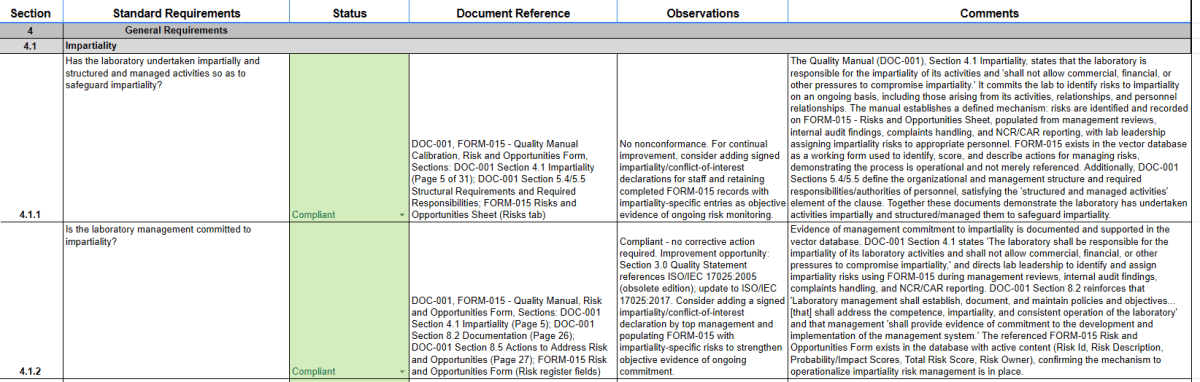
What the AI internal audit tool returns for every requirement
A compliant or noncompliant answer would not help much. Every audit question comes back with the evidence behind the call, the reasoning, and a recommendation you can act on.
A compliance determination
Every clause gets a clear call, so you can sort the whole checklist by what needs attention rather than reading it end to end.
The evidence, cited by document and page
Document title, revision, section, and page reference. This is the column your accreditation body asks you to fill in, produced for you.
An explanation tied to the requirement
Why that evidence satisfies the clause, or exactly what is missing. Your reviewer can accept, edit, or overturn the reasoning on the spot.
Observations and recommendations
A manual internal audit does not stop at conformity, and neither does this. The system flags thin documentation even where the requirement is met.
One consolidated audit record
Results live in a database, not a folder of spreadsheets. Export to Excel, or surface the same record in SharePoint, a web application, or your existing quality platform.
Noncompliant
Evidence reviewed- QM-001 Quality Manual, Rev 4, Section 8.9, page 24
- SOP-014 Management Review, Rev 3, Section 5.2, page 3
The procedure defines the review inputs, the frequency, and the participants, and it aligns with the requirement. No completed management review record appears anywhere in the document repository for the current cycle.
RecommendationHold and record a management review covering the inputs listed in SOP-014, then retain the record as objective evidence before your next assessment.
Illustrative example. Real output follows your own checklist and document set.
Six steps from your documents to a finished audit report
We build the AI internal audit tool around the way your organization already stores and controls its quality documentation. Your team selects a section and reviews the output. Everything between those two points runs on its own.
We connect a secure document repository
Google Drive, SharePoint, Microsoft 365, or another platform you already use. You upload the quality manual, procedures, policies, forms, and completed records that make up your management system.

The workflow builds a searchable evidence base
Word files, PDFs, and spreadsheets each get handled according to their type, split into sections, and converted into a vector database. The result is a retrieval system that reads your actual documents instead of guessing from general knowledge.
Your controlled documents become the source of truthWe configure the checklist and the evidence rules
Your standard, your audit checklist, your reporting format, and the AI model matched to the depth you want. We also restrict which document types count as evidence, so external guidance never gets cited as proof of your own conformity.
You choose a section and start the audit
Audit the whole standard, or take one section at a time. Enter the audit type, the auditor, and the date, and the system opens a new audit record with its own audit ID.

The system works through every requirement
For each question it searches the evidence base, weighs what it retrieves, reaches a determination, records the document references, writes the explanation, and adds observations. Results write into the audit record as it goes.
A qualified person reviews and approves
The audit routes for approval before anything is final. Your reviewer accepts, edits, or overturns the findings, and only then does the system populate the audit report.
Nothing is issued without human sign-offThree groups get different value from the same system
The work underneath is identical: read the documentation, map it to the requirement, and say where the evidence sits. What changes is the reason you need it.
Laboratories pursuing accreditation
You have written documents and you still cannot tell where the holes are. This is where the tool works hardest as a gap analysis engine.
- Find missing procedures and missing records before your assessment
- Fill the preliminary checklist with real document references
- Prioritize the work by what the standard actually requires
Accredited labs running internal audits
Clause 8.8 asks for an audit programme covering frequency, methods, responsibilities, planning, and reporting. Auditing by section keeps that programme moving all year.
- Audit Section 4 now and Section 7 next quarter under one audit ID
- Build a single consolidated record instead of scattered files
- Give your auditor a document map before they walk the floor
Accreditation bodies and assessors
Assessors read the same preliminary checklists that labs struggle to complete, across dozens of client files. Consistent evidence mapping changes how that review time gets spent.
- Every clause arrives with a document reference and a page location
- Less effort chasing paperwork, more effort on technical assessment
- The same approach scales across pre-assessment reviews
Finding the gaps a fast document review misses
The strongest argument for an AI internal audit tool shows up when it catches something a quick read would wave through.
Evidence sources you control
A document repository usually holds more than your own quality system. Guidance documents, standards interpretations, and reference material collect there during implementation.
You do not want an AI citing an external guide as proof that your laboratory conforms. So we restrict evidence to your approved sources: the quality manual, policies, procedures, forms, and completed records. Guidance stays available for context and never appears as evidence.
A model matched to the job
We tested several AI models against the same checklist, and they do not read requirements the same way. Some are generous. Others behave like a conservative assessor and flag missing evidence that a lenient model passes.
Speed, cost, and depth of analysis all move together. Need a map of where each clause is addressed? A faster model does that. Want a genuine internal audit? We configure a more capable model that weighs the evidence behind every requirement.
An auditing tool, not a replacement for an auditor
“AI models are not perfectly reliable. They interpret requirements differently, they miss information, and they occasionally reach the wrong conclusion.”
So we built the approval gate into the workflow rather than into the fine print. The system performs the document review and the evidence gathering. A qualified person reviews the output, corrects it, and approves it before the report exists.
Clause 8.8 still requires objective, impartial auditors. Nothing here changes that, and nothing here guarantees an assessment outcome.

Build it into your quality system, or hand us the documents
Most organizations want the AI internal audit tool running inside their own environment. Some want the result without the project. Both start with the same conversation.
Built into your quality system
We configure the full workflow inside your environment, then your team runs audits whenever you need them.
- Repository connected to your Drive, SharePoint, or Microsoft 365
- Your checklist, your report format, your evidence rules
- Audit by section across the year under one audit record
- Training so your quality manager owns the process
Run as a service by Precision ISO
Send us your quality system documentation and we return a reviewed gap analysis against the standard. No setup on your side.
- We build the evidence base and run the review on our side
- A Precision ISO auditor reviews every finding before delivery
- You receive a clause-by-clause report with prioritized actions
- A natural first step before a full implementation
What quality managers ask before we build one
Does the AI replace our internal auditor?
No. We treat this as an auditing tool, never as a replacement for an auditor. The AI performs the document review and the evidence gathering, which is the slow part. A qualified person reviews the findings, corrects anything wrong, and approves the audit before the report is issued. Clause 8.8 still requires objective and impartial auditors, and that requirement lives with your people.
What documents does the system need?
Your quality manual, standard operating procedures, policies, forms, and completed records. Word files, PDFs, and spreadsheets all work. The more complete your repository, the more useful the review, because the system can only cite what it can read.
It also recognizes the difference between a template and a completed record, which is often where the real finding sits.
Does it work with ISO 9001 as well as ISO 17025?
Yes. We demonstrate it against an ISO/IEC 17025:2017 checklist because that is where laboratory demand sits, though the same approach applies to ISO 9001:2015 and to other management system standards. The checklist and the evidence rules are configuration, not rebuilt code.
Where does our documentation live, and who can see it?
In your own accounts. We connect to the repository you already use, whether that is Google Drive, SharePoint, or Microsoft 365. We scope exactly what the workflow can reach during setup and document those connections so your team knows where quality system content travels.
Can we audit one section at a time?
Yes, and most laboratories should. Each audit gets an audit ID. Enter that same ID later and the results build into one consolidated report, so you can audit Section 4 this quarter and Section 7 next quarter while maintaining a single audit record for the year.
What does the finished output look like?
Our demonstration exports to Excel, though the format is a choice rather than a constraint. Results live in a database, so the same audit record can surface in a web application, a SharePoint site, or the quality management platform you already run.
How long does setup take?
That depends on the size of your document set, the checklist you use, and the reporting format you need. A single-standard AI internal audit tool build moves faster than a multi-site rollout. Book a call and we will scope it against your actual quality system rather than a generic estimate.
See what an AI internal audit tool finds in your quality system
Bring your current preliminary checklist, or just tell us which standard you work to. We will show you what the review produces, where it helps, and where it does not.
Precision ISO • Your Trusted Partner for ISO Success
Clause references point to ISO/IEC 17025:2017. Verify them against your organization's controlled copy of the standard. This service supports your compliance work and does not constitute legal, regulatory, or accreditation advice. Precision ISO does not guarantee any audit or accreditation outcome, which depends on how your organization implements, operates, and maintains its management system.